UDGOK - Upscale Development Group
Construction Technology โ€ข March 2026

The 2026 Guide to Digital Twin Technology

How AI, IoT, and 3D virtual replicas are transforming commercial construction, energy, and smart cities across Texas, Oklahoma, and California.

๐Ÿ“– 10 MIN READโ€ขBy UDGOK Intelligence
$48.2B
Market by 2026
52.7%
Healthcare CAGR
30%
Cost Reduction
8K
BIM Resolution
Quick Answer

A Digital Twin is a living, data-rich 3D replica of a building that syncs with real-world conditions through IoT sensors and BIM models. The global digital twin market is projected to reach $48.2B by 2026, with healthcare as the fastest-growing segment at 52.7% CAGR. In construction, Digital Twins detect MEP clashes (saving $5,000โ€“$50,000+ per conflict), simulate energy performance before equipment purchase, and reduce construction costs by up to 30%. UDGOK uses Digital Twins on every medical and commercial project to deliver zero-conflict builds.

What Is a Digital Twin?

A Living Virtual Replica of the Physical World

Imagine having a perfect virtual copy of something realโ€”a building, a machine, an entire hospital, or even a city. This virtual copy behaves exactly like its real-world counterpart, updating in real-time as conditions change.

Real digital twins connect to IoT sensors on actual equipment, pull in real-time data streams, and use advanced AI to predict problems before they happen and optimize performance automatically.
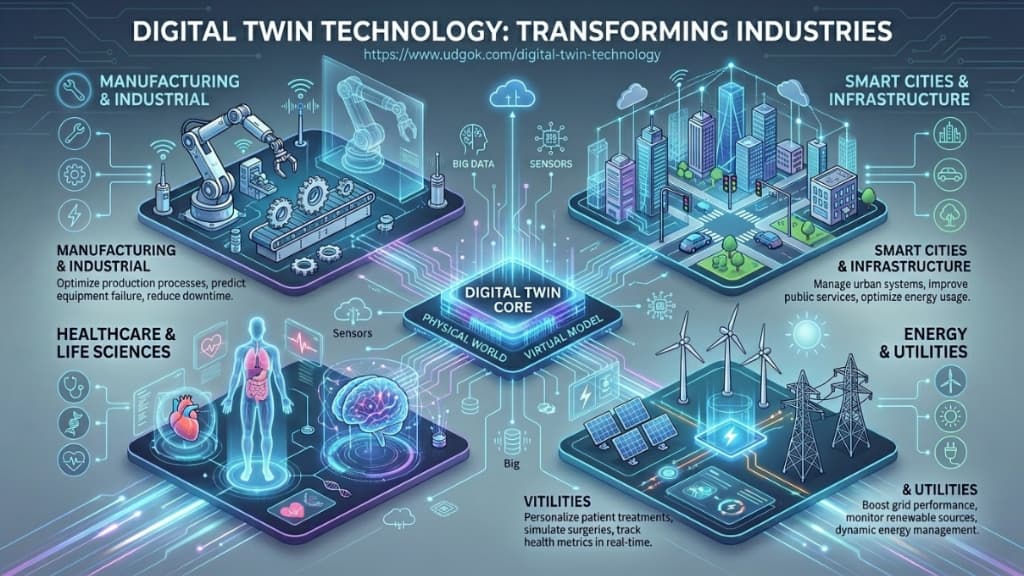
Digital Twin Technology transforming industries: Manufacturing, Healthcare, Smart Cities, and Energy
Technology Stack

The Engine Behind Digital Twins

๐Ÿ“ก

IoT Sensors

Continuous data collection from physical assets โ€” temperature, vibration, pressure, and performance metrics in real-time.

โ˜๏ธ

Cloud Computing

Scalable infrastructure to store, process, and analyze massive data streams with sub-second latency.

๐Ÿง 

AI & Machine Learning

Pattern recognition, predictive maintenance, autonomous optimization, and anomaly detection.

๐ŸŽฎ

3D Visualization

Photorealistic rendering powered by Unreal Engine for immersive facility exploration and clash detection.

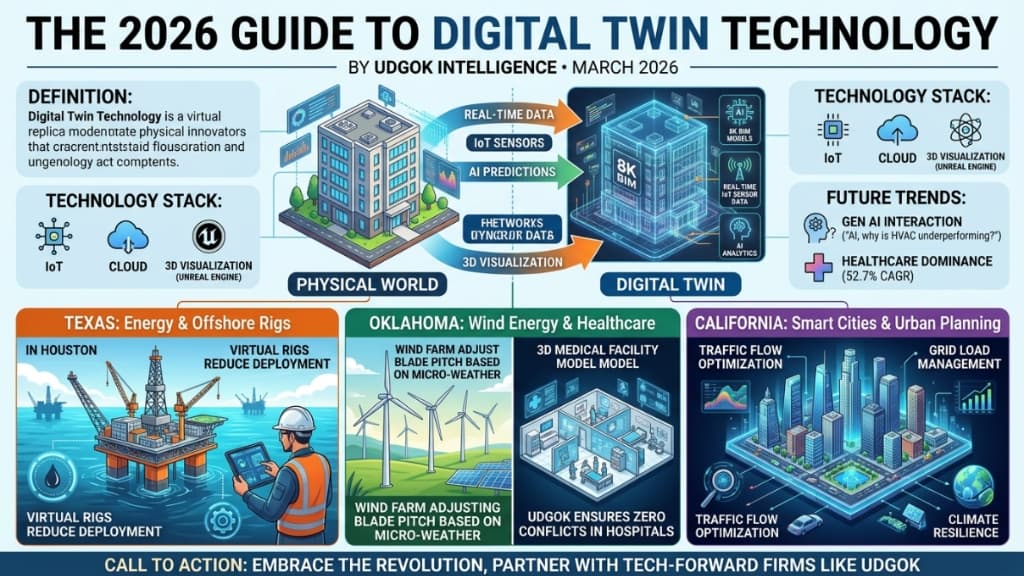
The 2026 Guide to Digital Twin Technology โ€” UDGOK Intelligence overview of Texas, Oklahoma, and California applications

Field superintendents comparing live building conditions against the 8K Digital Twin BIM model in real-time.

Live Demo

Digital Twin technology in action โ€” real-time 3D building visualization, IoT sensor integration, and BIM clash detection powering smarter construction decisions.

Regional Impact

Transforming Industries Across the Region

Texas

Energy & Offshore Rigs

  • โ†’ Virtual offshore rigs let Houston engineers troubleshoot without deploying helicopters
  • โ†’ Predictive maintenance reduces unplanned downtime by 45%
  • โ†’ Real-time pipeline monitoring across thousands of miles
  • โ†’ Refinery optimization saves $2M+ annually per facility
Click to expand
Oklahoma

Wind Energy & Healthcare

  • โ†’ Wind farms adjust blade pitch in real-time based on micro-weather patterns
  • โ†’ UDGOK deploys 3D medical facility models ensuring zero MEP conflicts
  • โ†’ Medical gas system validation before concrete is poured
  • โ†’ Hospital HVAC optimization reduces energy costs 25%
Click to expand
California

Smart Cities & Urban Planning

  • โ†’ Traffic flow optimization using city-scale digital twins
  • โ†’ Grid load management for renewable energy integration
  • โ†’ Climate resilience modeling for coastal infrastructure
  • โ†’ Building energy benchmarking across entire districts
Click to expand
What Lies Ahead

The Future of Digital Twins

2026

Gen AI Integration

Large language models enable natural language queries to facility systems: "AI, why is the HVAC underperforming on floor 3?" โ€” and get an instant, data-backed answer.

2027

Healthcare Dominance

Specialized digital twin platforms for healthcare facilities become the fastest-growing segment at 52.7% CAGR, revolutionizing hospital planning and operations.

2028

Autonomous Optimization

Digital twins begin making autonomous adjustments โ€” HVAC tuning, lighting schedules, and energy routing โ€” without human intervention.

2030

City-Scale Ecosystems

Interconnected digital twins span entire supply chains, utility grids, and urban ecosystems, enabling true smart city management.

Common Questions

Frequently Asked

A Digital Twin is a data-rich 3D virtual replica of a physical building that stays synchronized with real-world conditions via IoT sensors and BIM models. In construction, it allows teams to detect MEP clashes before building, simulate energy performance, track real-time schedule deviations, and serve as a facility management tool for the building's entire lifecycle.

Digital Twins reduce construction costs by up to 30%. Resolving an MEP clash in a digital model costs $0, versus $5,000โ€“$50,000+ to fix the same conflict in the field after construction. For a typical UDGOK medical or dental project, Digital Twin technology catches 50โ€“200 clashes that would otherwise become costly change orders.

UDGOK integrates Digital Twins into every project through Revit BIM modeling, Navisworks clash detection, and IoT-connected field monitoring. We build the entire project virtually before breaking ground, validate all medical gas and MEP systems digitally, and deliver an as-built Digital Twin model at project completion for ongoing facility management.

Healthcare construction is the fastest-growing Digital Twin segment at 52.7% CAGR. Other major sectors include energy (predictive maintenance for refineries and wind farms), smart cities (traffic and grid optimization), and manufacturing (production line simulation). The global Digital Twin market is projected to reach $48.2 billion by 2026.

Ready to Build with Digital Twin Technology?

Start with a specific problem. Partner with a tech-forward construction firm. UDGOK integrates BIM, IoT, and AI into every project we deliver.

Ready to Build in Oklahoma?

Let's discuss your medical, dental, or commercial construction project.

Start Your Project